
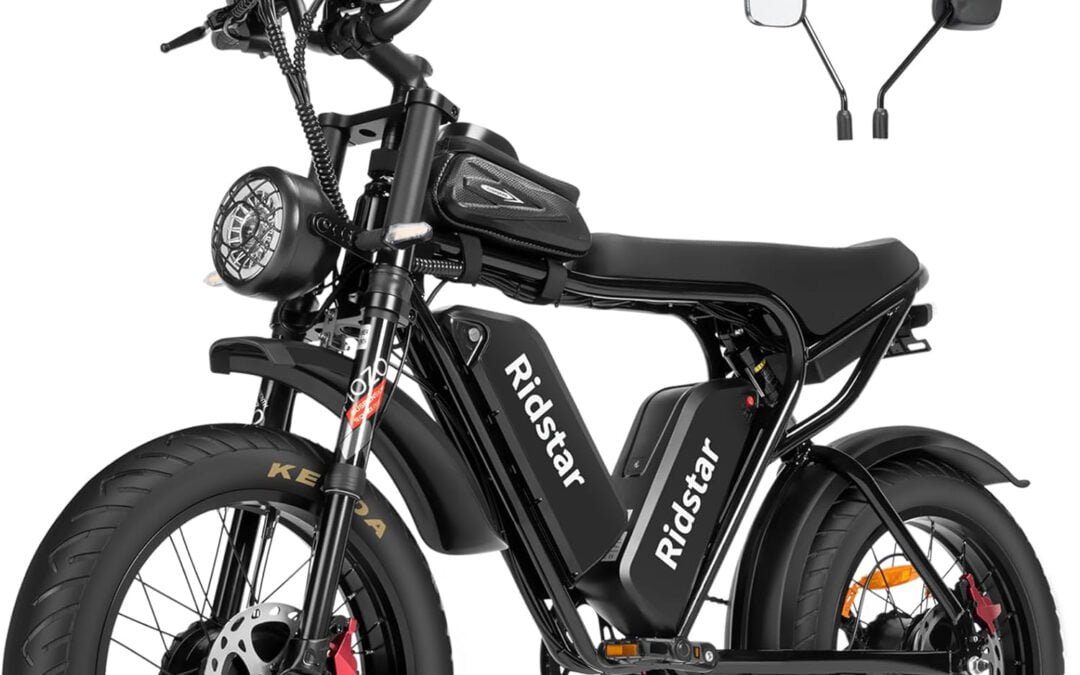
As electric bicycle technology has advanced, a major engineering revolution has taken the industry by storm: all-wheel-drive (AWD) dual motor electric bikes. By installing dedicated electric motors in both the front and rear wheels, dual-motor bikes deliver levels of torque, traction, and climbing performance that traditional single-motor bicycles simply cannot match.
However, does every rider actually need dual motors? Or is a quality single-motor e-bike the more practical and efficient choice? In this detailed breakdown, we compare dual-motor vs single-motor systems across hill-climbing prowess, handling, battery consumption, terrain versatility, and overall value.
How Does a Dual Motor Electric Bike Work?
In a standard single-motor e-bike, power is sent exclusively to either the rear hub or the crankset (mid-drive). In contrast, a dual motor electric bike—such as the flagship RIDSTAR Q20 Pro—utilizes two independent brushless hub motors:
- Front Hub Motor: Pulls the bike forward, providing immediate steering grip and pulling force through loose or slippery ground.
- Rear Hub Motor: Pushes from behind, bearing the bulk of rider weight and accelerating with immense mechanical leverage.
- Dual Controllers & Switch: Premium models feature handlebar-mounted switches allowing riders to toggle between single-motor mode (rear only, for battery saving on flat asphalt) and dual-motor AWD mode (for steep climbs and rough trails).
Major Advantages of Dual Motor E-Bikes
1. Unstoppable Hill-Climbing Ability
If you live in a mountainous region or frequently encounter punishing 25° to 35° inclines, single-motor hub bikes can quickly overheat, lose momentum, or force you to pedal aggressively. With two motors dividing the workload, torque output is doubled (often exceeding 160 Nm of combined peak torque), allowing you to power up steep forest inclines effortlessly without stalling.
2. All-Wheel Drive Traction on Snow, Mud, and Sand
Rear-wheel-only power frequently causes the rear tire to spin out on wet leaves, deep sand, muddy trails, or winter snow. AWD front-wheel pulling action keeps the bike tracking straight and stable, virtually eliminating fishtailing and dramatically increasing off-road safety.
3. Redundancy & Peace of Mind
When riding miles deep into remote backcountry trails, mechanical redundancy is a lifesaver. On a dual-motor machine, if a cable or controller on one motor ever experiences an issue, you can simply switch to the other motor and ride safely back to civilization.
4. Rapid Acceleration for Commuter Safety
Dual motors deliver instant, responsive acceleration from a complete stop. When navigating urban intersections or merging into traffic flow, having rapid punchy pickup gets you out of the danger zone instantly.
Drawbacks to Consider with Dual Motors
While the performance benefits are staggering, dual motors come with specific trade-offs:
- Added Weight: An extra motor hub, motor wiring, and dual motor controllers add approximately 4 to 6 kg to the total frame weight.
- Higher Power Consumption: Running both motors at peak power draws more current, requiring massive battery capacity—which is precisely why the RIDSTAR Q20 Pro is equipped with an industry-leading 52V 40Ah dual battery pack to ensure long distance range isn't compromised.
When Is a Single Motor the Smarter Choice?
A single-motor e-bike is often the ideal choice if:
- You primarily ride on paved city streets, flat bicycle pathways, and gentle rolling hills.
- You need a lighter frame that is easier to carry up apartment stairs or load onto car racks.
- You want maximum energy efficiency per watt-hour, such as on cargo-focused haulers like the KOOLUX X7 Pro.
Verdict: Which One Should You Buy?
Choose Dual Motor if: You want motorcycle-like adrenaline, hunt or fish in rugged backcountry, ride through winter snow or sandy beaches, carry heavier loads up steep hills, or want the ultimate high-performance electric bike experience.
Choose Single Motor if: Your daily journey consists of city commuting, paved park trails, and predictable weather where simplicity, lightweight handling, and maximum battery economy take priority.
Frequently Asked Questions
Can I turn off one motor to save battery on a dual-motor e-bike?
Yes! High-performance models like the RIDSTAR Q20 Pro include a handlebar switch that toggles between Single Motor (rear-wheel drive) for extended battery economy on flats, and Dual Motor (all-wheel drive) when extra hill-climbing power is required.
Do dual motors drain the battery twice as fast?
Not necessarily. While peak power consumption is higher, during steady riding both motors share the load. Because neither motor is straining at 100% capacity, thermal efficiency remains high. With a proper high-capacity battery (like 30Ah–40Ah), you will still achieve 80–120 km of riding range.
Explore our lineup of AWD champions in our Electric Bikes collection or check out replacement parts and upgrades in the Spare Parts catalog.
 English
 Español
 Italiano
 Deutsch